What Are Bridge Courses and Why Do They Matter?
The programmes are tailored to meet the educational needs of students who need to successfully complete different academic levels. These programmes attempt to meet the learners' needs and assist them move from one educational phase to the next.
The students who need help with bridging the learning gaps will most likely benefit from these courses. Their needs include more than a remedial programme.
College is not simple for anybody, especially for students just graduated from high school or earned their associate degrees from community college. Undergraduates contemplating on graduate school, all of them can benefit attending bridge courses for their predicted chances of academic success.
The number of states offering such programmes has rapidly increased, with 39 states incorporating some form of transition courses. 17 of those states have developed comprehensive transitional curricula which highlights the growing demand for academic transition support within the American educational system.
Available Types of Bridge Programmes within the Transition Period
High School to College Bridge Courses
Community college students can gain the academic and cultural skills needed to smoothly integrate to four year universities by attending the transfer bridge programmes. These efforts target the common challenges students encounter during transfer to ensure students make timely progress toward their degree completion goals.
Undergraduate to Graduate Bridge Programmes
Participants in Bridge Programmes are encouraged to apply to one or two year transitional graduate programmes that include tailored coaching and mentoring, advanced study, and research for seniors and graduates in the physical sciences.
Summer Bridge Programmes
The Hurricane Prep 2025 Summer Bridge Programme is meant for students admitted to high school, and provides additional support to helps students transition from high school to college. These intensive programmes generally start in the summer, in preparation for the school year.
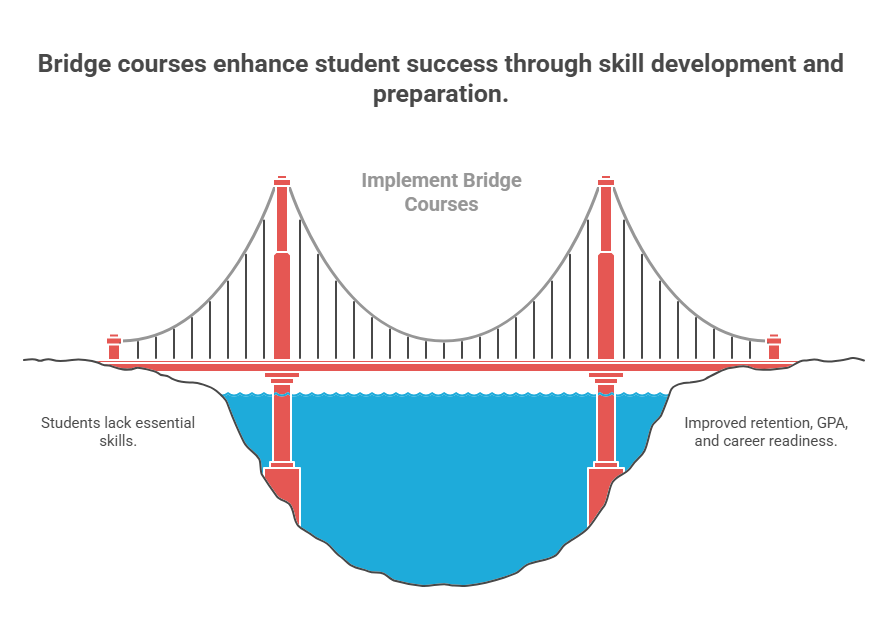
Key Benefits of Bridge Courses
Skill Gains
Gaps in skills deemed essential for that level of education are addressed in bridge courses. These programmes are designed to offer students scaffold instructional support in order to build foundational skills they will need to successfully start the school year.
Targeted Instruction is provided in the Following Areas:
- Advanced problem-solving and Mathematical reasoning
- Reading and Writing
- Studying and Managing Difficult Courses
- Researching and Citing
Better Retention Rates and Increased Success
Programmes designed to manage and control attrition have become very common in educational institutions. The explanation often given is the need to enhance success. A meta-analysis of 16 STEM summer bridge programmes showed that the bridge programme participation had a noticeable influence on retention rates, first year GPA, and overall retention rates.
Students attending bridge programmes are much more likely to finish within 6 years (10 percentage points) to community colleges and less selective four-year institutions.
Cultural and Social Preparation
In addition to having academic skills, bridge courses assist students with the transition to new educational settings. These courses make certain that students are able to work within the framework of the new system and, therefore, are cognisant of what their teachers expect, so that they can productively participate in the system.
Career Exploration and Goal Setting
Students in bridge courses are in a better position than their peers to work with other students to organise and plan activities that enable them to gain deeper knowledge of certain areas, which helps them to understand what they are good at, what they like, and what they want to achieve in their life. This helps them make better academic and career choices.
How to Apply for Bridge Courses
Step 1: Look At Programmes Offered
Start looking, find out about, or try to locate sponsorship bridge programmes at the, or nearby, your target institutions. Reach out to the admissions, academic, or a programme coordinator to get the:
- How long is the programme, and what are the hours?
- What are the academic disciplines?
- What documents are needed?
- How much is the programme and what financial aid is available?
- When is it due?
Step 2: Verify the Programmes Criteria
Most bridge programmes have a set of criteria, like:
- What are the minimum GPA standards?
- What is the accepted completion rate?
- What are the required courses?
- Fiscal constraints?
- First-generation college student?
Step 3: Assembled Required Materials
Prepare, also called complete, the set of documents that go together with the application:
- What is the application for completion?
- How many institutions and what are their branches?
- How many recommendation letters and what type are they?
- What are the goals and what is the certain statement?
- What is a resume with accompanying documents?
- There are some other documents attached as well.
Step 4: Submit Your Application
Be sure you are aware of the application deadlines, as these differ greatly:
- Summer bridge programmes: Applications are often due in the period March - May
- Fall semester programmes: Deadlines are usually between February - June
- Spring programmes: Applications are due between October - December
All materials should be submitted prior to the deadline, and it is best to check to ensure every document has been received.
Step 5: Complete Interview Process (If Required)
Some especially competitive programmes do require an admissions interview, so do the following:
- Go over the application thoroughly
- Prepare to articulate your ambitions and challenge areas
- Gather information on the specific programme and the institution
- Have intelligent queries about the specific programme ready
Step 6: Accept and Prepare for the Programme
Once you get accepted, you still need to do a few things:
- Health and immunisation records
- Send in the Housing applications (for residential programmes)
- Select courses or do an academic assessment
- Attend the Orientation session
Requirements and Qualifications
Most bridge programmes include students who can demonstrate basic academic competency, though the competency might also include areas for improvement include:
- Minimum GPA: Most programmes range from 2.0-3.0, depending on the programme level
- Test Scores: A number of programmes do require SAT/ACT scores within a range, and for some, placement tests are used
- Course Prerequisites: specific high school courses or college level ones need to be completed
Non-Academic Qualifications
Most bridge programmes do tend to favour students who stand a better chance in added support:
- First-generation college students
- Students coming from the equity-deserving groups
- Students who need financial support
- Students who have the willingness to work even harder in school
Special Circumstances
Some programmes focus on accommodation needs of specific groups of people:
- International students who need support in adjusting to the new academic and cultural environment
- Returning adult learners and students' have gaps in their education and have faced learning challenges
- Students' learning and experiencing disabilities
- Students' transferring from different academic systems
Conclusion
The first bridge courses taken by students miss out on and the most important to their success are the skills and self-assurance that can be brought from proper support and well-designed networks to help students make smooth transitions at different levels of their education.
The Texas College Bridge programme addresses the gaps in readiness between at-risk and academically prepared high school students and shows that students who may underperform seem to lack skill achievements on high-stakes standardised tests are able to succeed as well.
The structure on skill development paired with peer assistance and institutional support serves as the backbone for sustainable educational success in the case that reinforcement is required as students prepare for their first college experience, strategies towards transferring to a four-year institution and even Omni Plan for graduate school.
Frequently Asked Questions
How long is the duration of the bridge courses?
Programmes catered to the students are as follows:
- 4 to 8 weeks during summer
- 15 to 16 weeks in a semester
- Full academic year
- 2 year bridged graduate courses
- Bridge courses at the college level may allow for dual enrollment
- Some instructors offer development activities for which no credits are awarded
- Most graduate bridge programmes include graduate level coursework
What is the cost of bridge programmes?
The "cost" of programmes can range significantly:
- For those who qualify, many programmes are nil charge or reasonable
- University summer programmes may range between £800-£4000
- Most often, financial assistance and/or scholarships are available
- Some employers will sponsor bridge programmes as part of continuing education
Can I participate in multiple bridge programmes?
Certainly, students are likely to gain from taking multiple bridge experiences. There is, however, administrative "red-tape" that comes with each programme that needs to be managed.
Testimonial
Dr. Sarah Martinez, Advanced Academic Programmes' the Associate at the State University, "In my opinion, I am a first-generation college student and I come from a background where I faced a lot of challenges. The summer bridge programme in my opinion was the most helpful one throughout my college studies. It made me feel prepared. Rather than a student who is overwhelmed by the size of the programme, I became prepared and excited. The difference was me having peers who motivate me that as a result enabled me to learn the techniques to achieve success."